

Ringless voicemail (RVM) delivers a recorded audio message directly into a recipient’s voicemail-box without ever ringing their phone. Instead of dialing the device, slybroadcast’s patented technology hands your message straight to the phone carrier’s voicemail system. The recipient gets a normal new-voicemail notification, listens whenever they’re ready, and calls you back.

STEP 01
Slybroadcast connects directly to the carrier’s voicemail infrastructure and places your recording in the voicemail box. No call is placed to the handset, so there is nothing to answer, decline, or send to voicemail manually.

STEP 02
The phone doesn’t ring. The recipient simply sees the standard new-voicemail icon, along with the Caller ID you chose, exactly as they would for any other message.

STEP 03
People check voicemail the way they check email: when they have a moment and are ready to pay attention. That’s why ringless voicemail callbacks tend to be warm leads who have already heard your offer and chosen to respond.

STEP 04
Use a slybroadcast Callback Number as your Caller ID to see exactly who calls back from each campaign, forward those calls to any phone, and send an automatic follow-up text right after each voicemail lands so recipients can reply, click a link, or confirm an appointment.


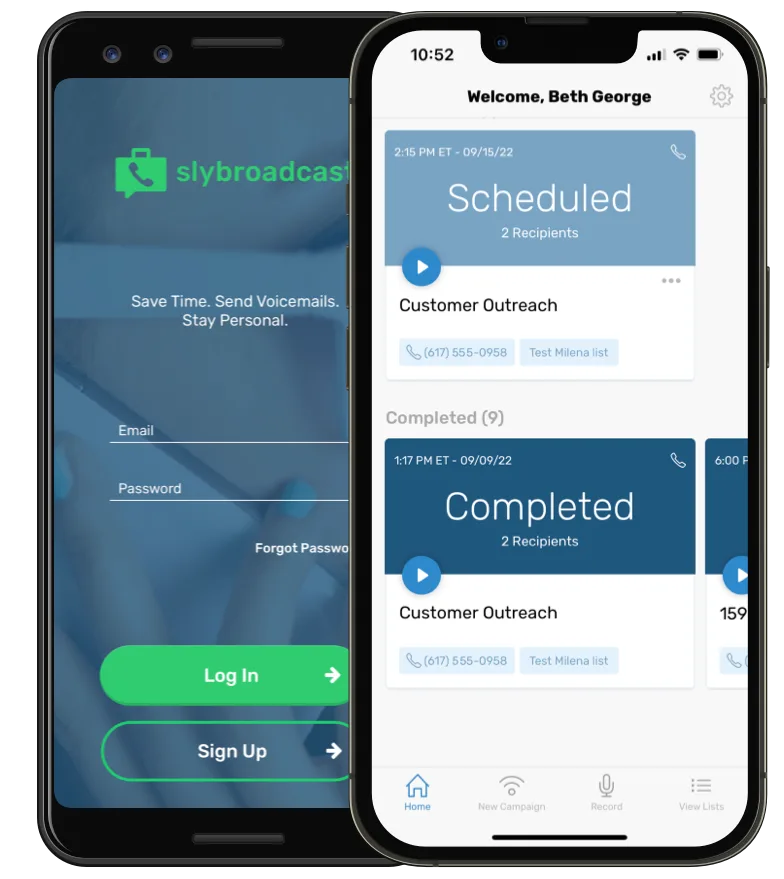


 Zapier, Make, Salesforce and Integrately integrations for campaign automation using external triggers

Ringless voicemail works! However, if you aren’t completely satisfied with your first voicemail marketing campaign, we’ll refund your money.
Your data and transactions are always protected — we are SOC 2 and PCI compliant, meeting the highest standards for security and privacy.
See Terms & Conditions.


Ringless voicemails can help qualify new leads, land new subscribers, and drive awareness with each voicemail drop that takes place. Using our cost-effective, patented technology, we're able to insert your voice message to your recipient's voicemail-box.

Earn credits for free voicemail deliveries when you share the benefits of the best ringless voicemail service out there: slybroadcast! When someone signs up with your referral code, we’ll give you and them 100 message credits each. There’s no limit to how much you can earn, and everybody wins. See your account dashboard to find your unique referral code, or contact us.


Curious as to how our direct to voicemail service could fit into your marketing strategy? Want to learn more about how to leave a voicemail without calling? Call our friendly sales team at (617) 399-9980
or email us at support@slybroadcast.com.

Ringless voicemails (RVMs) are one of the most efficient outbound marketing tools available. Reach hundreds of numbers with no dialing, and set up your first drop within minutes of creating an account. They can be used for several cases ranging from event notifications, fundraising, credit collection, CRM, political campaigns and outbound marketing.
As a telecommunications service, ringless voicemail is legal but is regulated like calls and texts. Regulations vary by use case: credit collection messages follow a different set of rules than political or marketing messages. Every slybroadcast customer should be aware of the regulations that impact their messaging campaigns.
The Federal Communications Commission (FCC) is an independent United States government agency responsible for implementing and enforcing America’s communications laws and regulations. Established by the Communications Act of 1934, the FCC regulates interstate and international communications across all 50 states, the District of Columbia and U.S. territories. States also have their own regulations, which vary from state to state. States can regulate telecommunications within their jurisdiction, such as local calls or messages, but interstate communications (calls or texts from one state to another) fall under FCC authority. The FCC is also the primary federal agency responsible for interpreting and enforcing the Telephone Consumer Protection Act (TCPA) rules.
In 2022, the FCC ruled that ringless voicemails count as calls under the TCPA. Read the ruling.
Non-marketing messages share information, like appointment reminders or account notices. Marketing messages promote a product, service or offer.
No. It depends on the number type and the purpose of the message (marketing or non-marketing).
This is general guidance, not legal advice. Consult an attorney about your use case.
